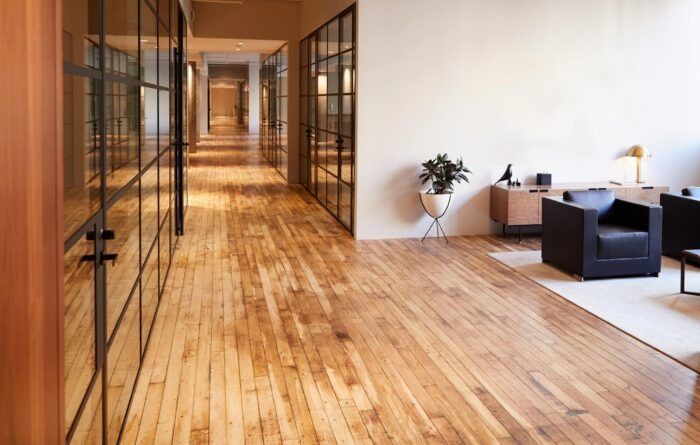
Timber floors in commercial buildings endure far more punishment than those in homes. Hundreds of people walking across them daily, office chairs rolling, furniture being rearranged, heels, trolleys, and constant cleaning all take their toll. Over time, the protective coating wears through, exposing the raw timber to moisture, staining, and accelerated wear.
This guide explains when commercial timber floors need sanding, what the process involves, how to choose the right finish, realistic 2026 costs, and how to schedule the work without disrupting your business.
Signs Your Commercial Timber Floor Needs Sanding
Visible Wear Paths — Dull, worn tracks where foot traffic is heaviest, particularly in corridors, doorways, and around reception desks.
Scratches & Scuff Marks — Accumulated scratches from furniture, heels, and equipment that cleaning can no longer remove.
Peeling or Flaking Finish — The polyurethane or lacquer coating is lifting, flaking, or turning white in patches.
Water Marks & Stains — Dark marks or grey patches where moisture has penetrated through worn finish into the timber.
Uneven Colour — Some areas still look good while others are noticeably duller — indicating the finish is worn unevenly.
If you are seeing any of these signs, a professional sand and refinish will restore the floor to like-new condition and protect it for another 7–10 years.
Full Sand vs Light Sand & Recoat
Full Sand & Refinish ($35–$65/m²) — The complete process. All existing finish is removed by belt and edger sanding, the timber is sanded smooth through progressively finer grits, and 3–4 coats of new finish are applied. Required when the existing finish is badly worn, damaged, or you want to change the floor’s stain colour. Downtime: 3–5 days.
Light Sand & Recoat ($20–$35/m²) — Also called “buff and coat”. The existing finish is lightly abraded with a rotary buffer, then 1–2 fresh coats of finish are applied on top. Suitable when the floor is still in reasonable condition but has lost its lustre. Faster and less expensive. Downtime: 1–2 days.
Our recommendation: For most commercial floors, a light sand and recoat every 3–5 years prevents the need for a full sand, extending the time between major restorations to 10–15 years. This is the most cost-effective approach over the life of the floor.
The Commercial Floor Sanding Process
- Assessment — We inspect the floor, assess timber type, condition, existing finish, and any repairs needed.
- Preparation — Furniture is moved (we can coordinate this). Nails are punched below the surface. Damaged boards are repaired or replaced.
- Sanding — Professional belt sanders remove the old finish and surface layer. Edge sanders and detail sanders reach corners and edges. Dustless systems capture 95%+ of dust.
- Staining (optional) — If you want to change or enhance the timber colour, stain is applied at this stage.
- Finishing — Three to four coats of polyurethane, lacquer, or oil finish are applied. Each coat is lightly sanded between applications for optimal adhesion. Water-based finishes dry in 2–4 hours between coats; oil-based in 8–12 hours.
- Final Inspection — We inspect the floor with you and ensure you are completely satisfied before clearing the site.
Scheduling Around Your Business
Floor sanding generates noise and requires the area to be unoccupied during sanding and while coatings dry. For commercial clients, we offer flexible scheduling to eliminate disruption:
After-Hours & Overnight — We sand and apply coats during evenings and early mornings.
Weekend Shifts — Full sanding projects completed over weekends when the building is empty.
School Holidays — All school floor sanding is scheduled during term breaks.
Staged by Area — Large buildings can be done section by section so the rest of the premises remains operational.
Frequently Asked Questions
How often should commercial timber floors be sanded?
A full sand and refinish is typically needed every 7 to 15 years in commercial environments, depending on traffic levels and maintenance. Light sand and recoat every 3–5 years extends the time between full sanding and keeps the floor in optimal condition.
Can you sand floors in an office without closing the business?
Yes. We schedule sanding during after hours, weekends, or staged by section so the office remains operational. Water-based finishes with low odour and fast drying (2–4 hours) minimise impact on adjacent occupied areas.
How much does commercial floor sanding cost in Melbourne 2026?
Full sand and refinish: $35–$65/m². Light sand and recoat: $20–$35/m². Costs depend on floor area, condition, and finish type. A typical 100m² office reception floor costs approximately $3,500–$6,500 for a full sand and three coats.
Get a Free Quote Today
Call us on 0419 810 810 or request a free measure and quote. We service all of Melbourne and regional Victoria — commercial and industrial premises only.